White Island BeachPhilippines Beach Guide
A vanishing white sandbar with a volcano for a backdrop
About
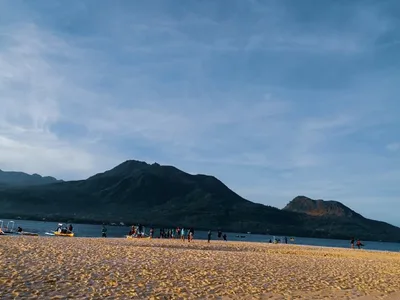
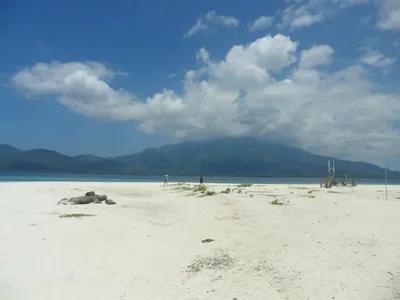
White Island is a tidal sandbar off the coast of Mambajao, Camiguin, rising from turquoise water with no trees, no buildings, and no shade — just a bright arc of white sand and open sky. The sandbar partially submerges at high tide, so the island you step onto in the morning may shrink to a sliver by afternoon. Across the water, the silhouette of Hibok-Hibok volcano dominates the horizon, giving every photograph a dramatic anchor. It's wild in the truest sense: exposed to the open sea, swept by wind, and completely unshaded. Busy with visitors during the dry season, it still feels raw and elemental in a way that few accessible beaches do.
How to get there
White Island is reachable only by bangka — the traditional outrigger boat — departing from Agoho Beach, a journey of around 15 minutes. Boats run daily, and there is no road access, no car park, and no way to arrive other than by sea. An environmental fee is required on entry; this goes toward marine protection and keeping the sandbar clean. Come prepared: there are no facilities on the sandbar itself.
Who it's for
For couples
The combination of a bare white sandbar, turquoise water, and an unobstructed volcano panorama makes White Island a genuinely striking place to spend a quiet morning together before the day-visitors arrive by bangka.
For families
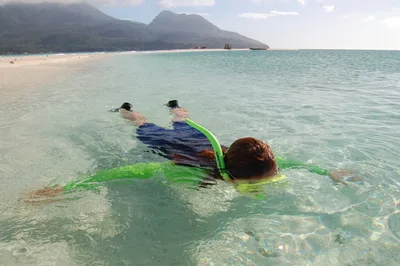
Families with older children who can snorkel will get the most from White Island, but parents should be aware that there is no shade, no facilities, and that strong currents near the sandbar edges require close supervision of young swimmers.
Our take
White Island earns its reputation, but go in with clear eyes. The exposed currents are real — snorkel near the sandbar edges with caution, and never underestimate the tidal shift that can swallow the sand beneath you. That said, the combination of white sand, turquoise water, and a live volcano on the horizon is as visually arresting as Philippine beaches get. It's busy during peak dry-season months, so an early bangka from Agoho Beach is your best move. Skip it entirely from July through October — typhoon season makes the crossing rough and the sandbar may not even be there when you arrive. Come between November and April, pay the environmental fee without complaint, leave nothing behind, and you'll understand why people make the trip to Camiguin just for this sandbar.
What to do
Snorkeling off the edges of the sandbar is the main draw in the water — the turquoise shallows give way to reef life just beyond the sand's edge. Back on land, the unobstructed view of Hibok-Hibok volcano, an active stratovolcano roughly 6.9 km away, is reason enough to linger with a camera. When you return to the main island, Ardent Hot Spring — about 5.1 km away — offers geothermal pools fed by volcanic springs in a forested hillside setting, a satisfying contrast to the open sandbar. The Sunken Cemetery, around 6.2 km away, is a sobering and historically significant site that rounds out a full day on Camiguin.
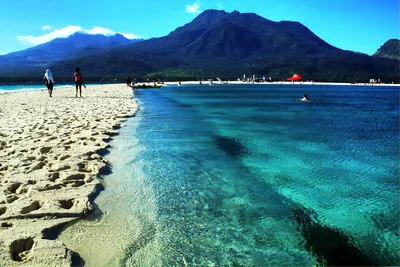
The classic shot is standing at the waterline where white sand meets turquoise water, with Hibok-Hibok volcano filling the background — shoot wide and shoot early.
At high tide, when the sandbar narrows to a thin strip and water surrounds you on both sides, the isolation and scale of the open sea make for a genuinely striking frame.
Where to eat
After the boat ride back, Northern Light and Mat's Restobar are both around 1.9 km from the departure point and cover local and international dishes. Alex, about 2 km away, is a solid nearby option for a post-sandbar meal. If you're after breakfast or something Italian, Sapore is worth the short trip at roughly 3 km out.
Where to stay
Seascape, about 2.3 km from the area, is the closest listed accommodation option for basing yourself near the sandbar. Staying on the Camiguin side means you can time your bangka departure for early morning, before the day's visitors arrive in numbers.
Photography
Shoot early morning when the light is soft, the white sand glows cleanly, and the full profile of Hibok-Hibok volcano is sharp against a clear sky. At the sandbar's waterline — especially where the turquoise water laps the white sand edge — you'll get the contrast shot that defines White Island.
Good to know
The sandbar partially or fully submerges at high tide — check tide times before you go and don't linger if the water starts rising around your feet. Currents off the sandbar edges can be strong, and the site is fully exposed to the open sea, so exercise real caution in the water. There is zero shade, so bring high-SPF sunscreen, a hat, and more water than you think you need. Overnight camping is strictly prohibited, littering is not tolerated, and the environmental fee is mandatory — respect the rules that keep this place worth visiting. Avoid July through October: typhoon season brings rough seas and can make the sandbar completely inaccessible.
Map
Nearby places
Seascape
White Island
Things to see around Mambajao
Hibok-Hibok Volcano
Active stratovolcano and the island's dominant landmark, with trekking routes to the summit.
Sunken Cemetery
Ardent Hot Spring
Geothermal pools fed by volcanic springs in a forested hillside setting.
GIFT
🎁 Gift this beach
Its exact coastline, your date, your words — on a print, a mug, or a PDF you print yourself.
White Island Beach
THAT DAY
White Island Beach, Northern Mindanao
© OpenStreetMap contributors
Clean & decorative, or “That day” with the real sky of your date.
Shipping included 3-6 business days
A question before you order? Contact us
Delivered within minutes on the confirmation page and by email: a ZIP with all 4 print sizes (30×40 cm, 12×16″, 50×70 cm, 18×24″), each as a high-resolution PDF and PNG (300 dpi), plus a screen version. Print at home or at any print shop.
Please complete the delivery address.
Please accept the Terms of Sale.
Almost there — the shop opens very soon.
Secure payment · Printed locally in 30+ countries · 7 languages
Frequently asked
The information on this page is provided for guidance only and may evolve. Access conditions, safety and infrastructure can change without notice. Always check official sources before traveling.
Other wild beaches in Philippines
Reviews of this beach
- No reviews yet, what a shame — leave yours and share your experience.
Photo credits
Sources and licenses for the photos shown above.
- Photo 1 — jackylim · source · CC BY-SA 3.0
- Photo 2 — Rick Lester Paredes · source · CC BY-SA 4.0
- Photo 3 — Khdamayo · source · CC0
- Photo 4 — justDONQUE.images · source · CC BY 2.0